


Alar Reduction (Nostril Reduction): Inner, Outer or Combined Incision?

Key takeaways
- The incision for alar reduction depends on what needs reducing: an inner incision for large nostrils, an outer incision for wide alae, and a combined incision for both.
- A wide tip or asymmetry may call for tip cartilage binding as well.
The short answer: is it the nostrils or the width of the alae?
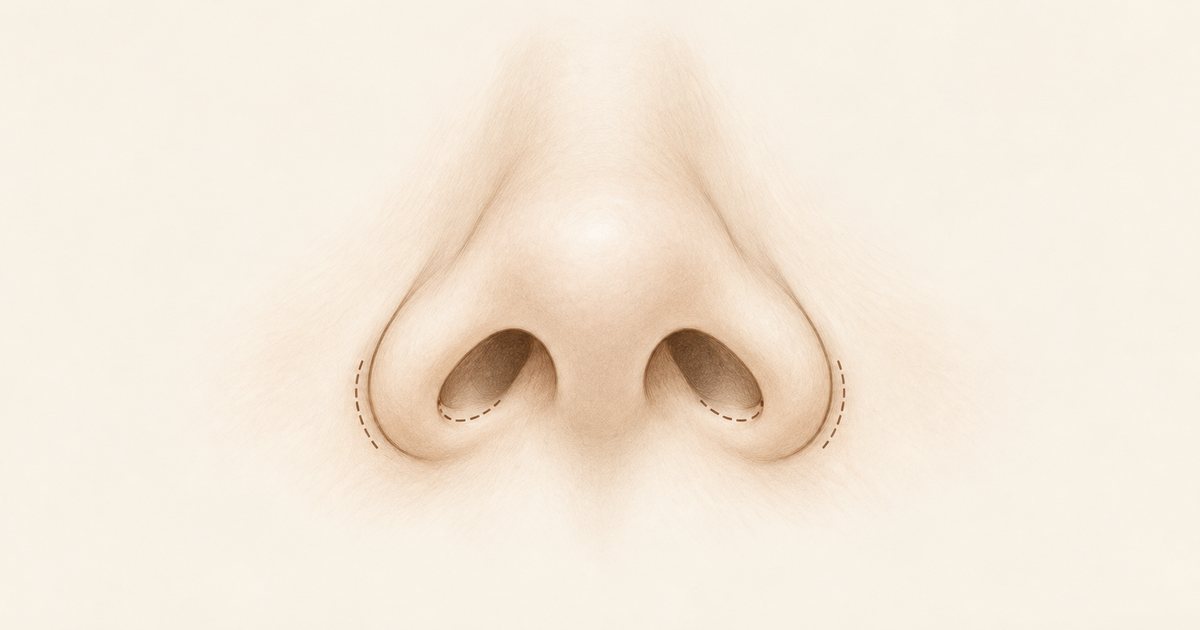
The incision method for alar reduction depends on what needs to be reduced. An inner (internal) incision is used to make the nostrils smaller, an outer (external) incision is used to narrow the side-to-side width of the alae (the nostril wings), and a combined inner and outer incision is used when both are needed.
You can get a rough preview in front of a mirror by gently pressing both nostril wings inward with your fingertips. Notice which change you like: smaller nostrils, or a narrower overall nose width. Your answer points to the incision method that suits you.
Five reasons the nose can look wide at the base
In consultations we often hear, "My nose isn't low, but it looks spread out," or "My nose stands out in every photo." The concern may sound the same, but the cause differs from person to person.
- The alae themselves flare out to the sides
- The nostrils are round and large
- The muscles around the nose make the alae spread further when you smile
- The bridge is fine, but the tip and alae look blunt and heavy
- The skin and soft tissue of the nostril wings are thick
Whether the cause lies only in the alae, or also in the nasal tip or the columella (the column between the nostrils), decides whether alar reduction alone is enough or another procedure should be considered with it.
The three incision methods at a glance
| Method | What it mainly reduces | Scar location | A good fit when |
|---|---|---|---|
| Inner incision | Nostril size | Inside the nostril | The outer shape of the alae is fine, but the nostrils are large |
| Outer incision | Side-to-side width of the alae | The shadowed underside at the base of the ala | Nostril size is fine, but the nostril wings flare out to the sides |
| Combined inner and outer incision | Both nostril size and width | Inside the nostril, plus a short outer line | The nostrils are large and the alae are also wide |
Inner incision: when the nostrils are large

The inner incision removes tissue mainly from the inside of the nostril. The nostril opening becomes smaller by the amount removed, which suits people whose nostrils look large from the front or from below.
Because the incision line sits close to the inside of the nostril, the scar is hard to see. However, since only the inside is reduced, the effect on the overall width of the nose is limited. If the alae are also wide, an inner incision alone may leave you feeling that "my nostrils are smaller, but my nose still looks wide."
Outer incision: when the alae are wide

The outer incision removes skin from the outside of the ala to reduce the side-to-side width. It suits people whose nostril size is fine but whose nostril wings extend out to the sides, making the nose look broad and flat.
How far should the outer incision line go?
With an outer incision, the length and position of the incision line matter most. At RISE Plastic Surgery, we limit the outer incision to the shadowed underside at the base of the ala. If the incision extends higher, onto the side wall of the nostril wing, the scar can be visible from the front, and a scar in that position is difficult to improve even with further surgery.
Combined inner and outer incision: reducing nostril size and width together

If you want both smaller nostrils and a narrower width, a combined incision on the inside and outside is usually the right fit. When the nostrils are reduced from the inside and the outer incision is kept as short as possible, the amount of width that can be reduced is relatively large for the length of the scar.
The incision is designed to end within the line hidden by the natural shadow of the ala, so the scar sits where it is hard to notice from the front.
How is non-incisional alar reduction different?
The non-incisional method does not remove any skin. Instead, a very small puncture is made beside each nostril wing, and a suture is used to pull both alae inward and tie them. There is almost no visible scar and the procedure is short, about 10 to 20 minutes, but the nostrils stay the same size; only the width is drawn in by the tension of the thread.
As the mouth moves, the knot can loosen, or even if it holds, the thread can gradually cut into the tissue so that the pulling force weakens. In many cases the nose returns toward its original width over time. Because the thread pulls the alae inward, the middle of the columella can also become more prominent, making the nose look upturned. For thick or widely flaring alae, rather than choosing the non-incisional method only out of concern about scars, we first recommend an incision that removes only what is needed, within the area where the scar can be hidden.
When alar reduction alone may not be enough
Often the reason the base of the nose looks wide is actually the tip. If the tip cartilage is large and splayed and only the alae are reduced, the proportion between the alae and the tip can look off, and the tip may look even more bulbous. In this case, combining alar reduction with nasal tip cartilage binding, which brings the tip cartilage together, can refine the tip and the alae together without an implant. If the tip also needs more height, we may discuss RISE Dual Nose, which adds your own ear cartilage.
When the nostrils differ in size from side to side, we also look at the cause first. If one ala is simply larger, the larger side can be reduced more to match. But if the columella is bent or the tip cartilage leans to one side, those also need to be corrected. A difference in alar height caused by a height difference between the two sides of the face cannot be fixed with surgery, so the goal is a natural balance rather than perfect symmetry.
What recovery looks like
| Timing | What to expect |
|---|---|
| Day of surgery to day 2 | Once the local anesthetic wears off, there may be some pain for a day or two, so take the prescribed pain medication. Severe pain is uncommon. |
| Days 2 to 3 | The area above the upper lip and the nostril wings are swollen, and the shape looks its most awkward. This is not the final result, so there is no need to worry. |
| Day 3 | Stitches are removed. There are about two on each side, and transparent sutures are used, so they are not very noticeable. |
| 1 week | The shape settles and looks much more comfortable. |
| 2 weeks | Most of the major swelling has gone, and the early redness of the scar has faded considerably. |
| 1 to 3 months | The scar fades further toward your natural skin tone. As the swelling goes down, the alae may feel slightly wider than right after surgery; in most cases this is simply the nose settling into the planned shape. |
| 6 months | The scar tissue softens. If you want further reduction, revision is discussed after this point. |
Our principles for minimizing scars
Skin type plays a role in scarring, but how much tissue is removed and how it is sutured matter more.
- We remove only what is needed, cleanly.
- The muscle and deeper tissue are first sutured in their correct position, which reduces the tension on the skin closure.
- The alae have many sebaceous (oil) glands, and stitches left in too long tend to leave marks, so we remove them on day 3.
- After surgery, sun protection and scar ointment help reduce pigmentation.
What to avoid for two weeks after surgery
Even after the stitches come out, the tissue underneath has not fully healed. For one to two weeks, avoid expressions that strongly stretch the area above the upper lip and the alae, and avoid rubbing or pulling on the nostril wings, as the incision could open. Normal smiling and talking are fine.
What to check during your consultation
- Whether the wide look comes from the nostrils, the alar width, or both
- Whether the outer incision is designed to end within the shadow of the ala
- How much to reduce relative to your face width and the distance between your eyes, and whether there is a risk of over-reduction
- Your skin thickness and the thickness of the nostril wings
- Whether the tip or columella means another procedure, such as cartilage binding, should be considered
- If there is asymmetry, which parts surgery can correct and which it cannot
Once alar tissue is removed, it is difficult to restore. If too much is removed, the nostrils can become narrow slits, or the alae can almost disappear so the tip looks blunter, and these results are hard to correct. That is why it matters to check not only "how much to reduce" but also "whether the reduction is only as much as suits your face."
This column is based on the explanations of alar reduction that Dr. Lim Jungtaek of RISE Plastic Surgery has written on his blog (in Korean).
Frequently asked questions
Will an inner incision alone make my nose look narrower?
An inner incision removes tissue from inside the nostril to make the nostrils smaller, so its effect on the overall width of the nose is limited. If the alae are also wide, we discuss a combined inner and outer incision, which adds an outer incision.
Is the outer incision scar visible from the front?
If the outer incision is limited to the shadowed underside at the base of the ala, it is hard to see from the front. The early redness usually fades considerably by about 2 weeks and then moves closer to your skin tone over 1 to 3 months. This varies with skin type.
When are the stitches removed?
On day 3 after surgery. The alae have many sebaceous glands, and stitches left in too long tend to leave marks. There are about two stitches on each side, closed with transparent sutures.
Is non-incisional alar reduction enough?
It can be considered if the alae are only slightly wide. However, because it works by pulling the alae together with a thread, the knot can loosen or the thread can cut into the tissue, and the nose often returns toward its original width over time. It does not reduce nostril size, and for thick or widely flaring alae an incision method holds up better.
Will my nose widen again over time?
With an incision method, it is unlikely to widen back to how it was before surgery, and most of the effect is maintained. Right after surgery the nose looks narrower because of swelling, and as the swelling goes down over 1 to 2 months it may feel slightly wider; in most cases this is the nose settling into the planned shape. The alae moving when you smile is normal muscle movement, not a relapse.
Can I have revision surgery if I want a further reduction?
Yes, if there is room to reduce further without the nostril shape becoming unnatural. Scar tissue takes 6 months or more to soften, so we recommend a consultation at least 6 months after the first surgery.
References
- Alar Reduction: Surgical Methods and Before-and-After Changes (Korean) (opens in a new window)blog.naver.com
- Worried About Wide Alae? Solving It with Alar Reduction (Korean) (opens in a new window)blog.naver.com
- My Nose Isn't Low, but It Looks Spread Out: A Woman in Her 20s and Her Alar Concerns (Korean) (opens in a new window)blog.naver.com
- Non-Incisional Alar Reduction: Method and Effects (Korean) (opens in a new window)blog.naver.com
- Non-Incisional Alar Reduction: Do the Results Last? (Korean) (opens in a new window)blog.naver.com
- Alar Reduction and Tip Cartilage Binding: When Is It Good to Combine Them? (Korean) (opens in a new window)blog.naver.com
- Nostril Asymmetry: How Much Can Surgery Correct? (Korean) (opens in a new window)blog.naver.com
- Swelling, Scarring and Pain After Alar Reduction: What to Expect (Korean) (opens in a new window)blog.naver.com
- Things You Should Never Do After Alar Reduction (Korean) (opens in a new window)blog.naver.com
- Do the Alae Widen Again After Alar Reduction? (Korean) (opens in a new window)blog.naver.com
- When Alar Reduction Revision Is Needed, and How to Prevent It (Korean) (opens in a new window)blog.naver.com
- RISE Plastic Surgery Alar Reduction page (opens in a new window)riseps-en.com
This article provides general medical information. Surgical methods, recovery time and results vary from person to person, so please consult a board-certified plastic surgeon before making a decision.

 02-515-9101


